Wednesday, July 27, 2016

M&A Missteps and Yahoo's decline

While companies such as Google have built significant value as result of a well-considered mergers and acquisitions strategy, Yahoo seemed to squander value. What role did merger-and-acquisition missteps play in Yahoo’s slow death?

http://goo.gl/mrtw0L

Thursday, June 16, 2016

Can Microsoft Lock-In LinkedIn Value?

For Microsoft’s acquisition of LinkedIn to be successful, integration not only must establish an appropriate starting point (preservation). But even more important is determining the path to the desired objectives and speed on the integration path to symbiosis and realization of revenue synergy.


Friday, August 14, 2015

Is Google/Alphabet the next Berkshire Hathaway?

Will Alphabet (formerly Google) become the Berkshire Hathaway of the 21st century? While some have viewed the comparison as silly, the question deserves further analysis. After all, Larry Page has often expressed his admiration for Berkshire's holding company structure.

Reasonable people will differ in their opinions about the validity of this comparison. While others may concentrate on differences, my emphasis will be on similarities. I'll focus on the M&A activities of the two companies.

Role of M&A in building the companies
Both companies have been voracious acquirers. Since 2010, Berkshire has purchased some 15 companies, while Google has acquired a whopping 125. Of course, many of Google's targets have been small acqui-hires, whereas Berkshire's typical deal is elephant-sized. Indeed, in his 2014  annual letter, Buffett states that he is interested in companies with at least $75 million in pre-tax earnings. Most of Google's acquisitions are far, far away from that number in revenue.

While Buffett has built Berkshire through inorganic growth coming from established companies, Page has developed Google largely through semi-organic growth, which blends existing internal capabilities with acquired external technological talent and resources from developing ventures.

But both companies have become M&A masters, nurturing this form of corporate development into a core strategic capability.

Cash is the fuel for M&A

For both Berkshire  and Google, cash generated from highly successful core operations has been the fuel for M&A. For Berkshire, the cash float from insurance has been a major support. For Google, the fuel has come from rapidly growing high-margin advertising revenue.

Both companies have shunned the use of stock in acquisitions. Buffett has famously declared that he and Charlie Munger would rather prepare for a colonoscopy that use Berkshire stock in a transaction. There have been few exceptions, with Burlington Northern being prominent. Google has used stock in only four major acquisitions, Applied Semantics, YouTube, On2, and AdMob.

M&A integration styles

Berkshire and Google are both obsessed with perfecting M&A integration. For Berkshire, this has largely meant becoming excellent at the art of preservation, allowing great management to continue running companies post-acquisition. For Google, integration has become an artful science with the goal of achieving an alchemic blend of existing and newly acquired talent and technology.

Bottom line on Alphabet mirroring Berkshire Hathaway? Page states that Alphabet can be parsed into alpha-bet, with alpha signaling returns above benchmark. While Page has not emphasized the "bet" piece of the parse, it's clear that what Alphabet is attempting is riskier than what Berkshire does.

It's taken Berkshire Hathaway about 50 years to grow into a $350 billion market cap company. Google has reached $450 billion mark in some 15 years.

I like the alpha bet that Alphabet will become the world's first trillion dollar market cap company over the next five years.

Sunday, July 26, 2015

Driverless cars as a service: $16B+ for Google?

This past Friday four UCLA Anderson EDGE student teams competed in a case competition involving the future of autonomous vehicles (AVs). Teams were assigned to Google, Mercedes-Benz, Tesla, or Uber and were tasked with how each company should innovate in order to enhance its position in the battleground for the future of the automobile.

The Google team won, recommending that Google should enter the AVaaS (autonomous vehicles as a service) market. The team estimated that this initiative (which they code named GOOSE) could yield $16 billion in direct, transportation-related annual revenue for Google starting in the year 2020. The team assumed pricing for on-demand car services would fall by 50%, given that the "driver dude" would no longer be needed. (Of course, this analysis assumed that regulatory and other issues can be resolved.) In addition, the team estimated that Google could earn up to $7 billion in additional advertising related to this service.

The team argued that Google should "go to war" against Uber and become the leader in next-generation on-demand vehicle services. This possibility of  this battle has been widely reported on in the press. For example, in February, Business Week reported that Google was developing its own Uber competitor. Google was coy about its future plans, tweeting "we think you will find that Uber and Lyft work quite well. We use them all the time."

In 2013, Google Ventures (GV) invested $258 million in Uber at a reported post-money valuation of $3.8 billion. Since GV operates largely independently of Google with a prime directive of generating capital gains, it's not unheard of for GV to invest in potential competitors of its parent.

Uber, given the possibility of having to go head-to-head with Google, has not stood still. In March, Uber acquired DeCarta, a map-tech company. Then in May, Uber lured 40+ robotics researchers away from Carnegie Mellon University to significantly enhance the capabilities of its own robotics research center in Pittsburgh.

If the EDGE team is correct in estimating this market opportunity for Google, fasten your driverless seat belts.

Tuesday, July 7, 2015

Will Twitter's acquisitions in 2015 turn the company?

Twitter may be changing its CEO, but the company's M&A machine has certainly not been stuck in neutral. Our infographic depicts six acquisitions the company has made during the first half of 2015.

Overall, Twitter's acquisitions are continuing to move away from acquiring companies that build the core social network to companies that support monetization efforts. Consider some examples.
  • In January, Twitter acquired Periscope, which allows users to upload live video wherever they are and broadcast it for followers to watch. The consideration was estimated at less than $100 million in cash and stock, but skewed towards cash. The acquisition reflects Twitter’s move to bolster its video capabilities. Adding the ability to stream live video on Twitter capitalizes on the company’s strengths as a real-time broadcast service. This fall, Twitter plans to launch Project Lightning, which will provide special live event coverage for both Twitter users and non-users.
  • In April, Twitter acquired TellApart, which helps retailers leverage data by personalizing the customer experience and drive omni-channel commerce. According to an SEC filing the consideration was $533 million in stock. TellApart's integrated suite of marketing solutions has allowed marketers to deliver personalized messages in real-time across platforms such as display ads, Facebook, and email.
  • In June, Twitter acquired Whetlab, which develops technologies for machine learning, a branch of artificial intelligence that utilizes algorithms to detect patterns in big data and to make recommendations and predictions. Possible uses of Whetlab technology by Twitter include: 1) improving a user's tweet timeline; 2) enhancing the company's ability to target ads; 3) licensing data. While Google has information about user's search and Facebook has information about what people are doing, Twitter's cache of data is distinctive in capturing what "influencers" are thinking. Whetlab could help Twitter pattern such data into trends that are of high value to both consumers and businesses.
M&A success is about sound strategy, valid valuation, and intelligent integration. Twitter appears to have delivered on the first two elements. Let's see if it can pull off the third.

Saturday, June 20, 2015

Apple and Google algorithm for acquisition goodwill

When a company makes an acquisition it must identify and value the assets of the target and allocate net purchase price to these assets. If net purchase price exceeds identifiable net assets the balance is assigned to goodwill.

Now consider Apple and Google acquisitions over the past two years, for which these companies disclosed specific purchase price and associated goodwill.
  • Apple acquires Beats (music streaming): purchase price = $2.6 billion; goodwill = $2.2 billion. Goodwill percentage of purchase price = 85%
  • Google acquires Waze (crowd-source traffic information): purchase price = $969 million; goodwill = $841 million. Goodwill percentage = 87%
  • Google acquires Nest Labs (smarthome devices): purchase price = $2.6 billion; goodwill = $2.3 billion. Goodwill percentage = 88%
  • Google acquires Dropcam (smarthome monitoring): purchase price = $515 million; goodwill = $452 million. Goodwill percentage = 87%
  • Google acquires Skybox (nano-satellites): purchase price = $478 million; goodwill = $388 million. Goodwill percentage = 81%
No need to hire a Duff & Phelps or Houlihan Lokey. Looks like the algorithm is simple: goodwill allocation percentage must be a two-digit number staring with an 8!


Saturday, June 13, 2015

Innovation fuel: M&A or R&D?

One measure that indicates the extent to which a company intends to innovate internally or externally is the ratio of acquisition investments to R&D expenditure. Let's call this M&A/R&D.

During 2013, Apple's M&A expenditures were $496 million, while R&D amounted to $4,475 million. Thus M&A/R&D was 11.1%. In 2014 with the acquisition of Beats (eventually booked as a $2.6 billion cash acquisition), total M&A dramatically increased to $3,557 million. R&D expenditures were $6,041 million. And M&A/R&D mushroomed to 58.9%.

Consider Google. During 2013, the company purchased Waze for consideration of $969 million. Total acquisitions for the year added up to $1,458 million, and R&D amounted to $7,137 million. Hence Google's M&A/R&D for the year equaled 20.4%. Then (as was the case with Apple, M&A accelerated in 2014, with acquisitions that included Nest ($2.6 B), Dropcam ($517 M), Skybox ($478 M). Total acquisition investments summed to $5,061 million, while R&D grew to $9,832 million. For this year M&A/R&D was 51.5%.

Three takeaways.

1) The M&A/R&D ratio is hardly stable. In particular, it's highly sensitive to years in which large deals take place.

2) Much of present and future R&D can be related to past M&A. So the impact of M&A on innovation efforts may be understated.

3) For technology companies such as Apple and Google, the trend for M&A to fuel a large part of company innovation is likely to persist.

Tuesday, June 9, 2015

Twitter's acquisitions point to monetization

So far in 2015, Twitter's acquisitions are moving away from buying companies that build the core social network to companies that support monetization efforts and build MAUs (monthly average users).

Not a completely new strategy, but the corporate business development direction has become more clearly tuned to top-line growth.

The monetization potential for Periscope, a mobile live-streaming app that lets users shoot and broadcast video to followers in real time, is particularly promising.

See our infographic depicting Twitter's 2015 acquisitions at www.trivergence.com/market.asp?MarketID=4208

Saturday, June 6, 2015

Apple creating augmented reality ecosystem via M&A

The time has come for power tech companies to build augmented reality (AR) ecosystems. Augmented reality involves overlaying digital media and information on the real world. Think pointing a smartphone at a restaurant from a distance and automatically seeing its menu and Yelp ratings appear on your screen.

Google's Glass, much maligned but certain to re-surface with improved design, is a prominent instantiation of the technology,

Apple's recent M&A activity signals a ramp up of its own AR ecosystem.

Organizational ecosystems can be built using influence or using control, Taking an influence approach implies emphasizing partnership or minority investment arrangements, whereas control suggests acquisition or majority ownership.

When Apple built its original music ecosystem in the early 2000's, it influenced music labels to license content in order to build the iTunes platform. Now as Apple enhances its augmented reality capability, it is initially using control via M&A to build an AR ecosystem.

Consider three recent Apple acquisitions.

  • In late 2013, Apple acquired PrimeSense, a developer of 3D machine vision technologies for digital devices for an estimated $360 million. PrimeSensor is a system on a chip and a 3D sensing device that can see, track, and react to user movements. The company had worked with Microsoft to develop its successful Kinect motion-sensing gaming/television technology.
  • In April 2015, Apple acquired LinX Imaging for an estimated $20 million. LinX develops miniature cameras for use in tablets and smartphones. The company's cameras capture multiple images simultaneously using proprietary algorithms that can assess depth and create 3-D image maps. The acquisition continued Apple’s pattern of deals in Israel. (PrimeSense was also based in Israel.)
  • Then last month, Apple acquired Metaio, which creates technology that blends real-world imagery and computer-generated elements into video presentations. Metaio's augmented reality technology has been used to develop virtual product showrooms by retailers as well as visual repair manuals for industrial equipment.
M&A ecosystem clusters signal a company's future movement. Apple is clearly intent on throwing its design expertise behind building cool AR products and experiences to show off in upcoming Developers Conferences.

Thursday, May 7, 2015

Robots, start your engines

The Indianapolis 500 automobile race has been a Memorial Day tradition in the United States since 1911, going back almost as far as the last time the Chicago Cubs won the World Series in 1908. (We Cub fans live on in everlasting hope and frustration!) The dramatic starting command of the race is: "Gentlemen, start your engines," which is modified to "Ladies and Gentlemen, ..." when female drivers are in the race.

Could this starting command be further modified for races in the decades to come?

In early 2014, Google acquired DeepMind for a reported $625 million. DeepMind is an artificial intelligence company that builds learning algorithms for applications such as recommendation systems for e-commerce. The company was founded by neuroscientist Demis Hassabis (former chess child prodigy and master gamer), Jaan Tallin (Skype and Kazaa developer), and Shane Legg (researcher).

Google's acqui-hiring of Deepmind helps it compete against other players focusing on deep learning. Facebook has recruited Yann LeCunn (former NYU professor) to head the company's artificial intelligence lab. IBM is investing $1 billion in its Watson supercomputer division that is working on deep learning to support applications such as medical diagnosis. Yahoo acquired the LookFlow team to lead its deep learning initiative. And on it goes.

The field of artificial intelligence (AI) has undergone several cycles of boom and bust since AI was christened and sent out the door with research momentum at The Dartmouth Conference of 1958 organized by Marvin Minsky and others. Periods of buoyant optimism for the technology have given
way to AI winters. But in 2014, an AI spring had returned. Google’s purchase of DeepMind  reflected the new-found confidence in what AI could accomplish in multiple business sectors of interest to Google.

In March 2015, Google's DeepMind team revealed an algorithm that can teach itself from scratch to play early computer games with skill equal to or better than a human. The team eventually plans to work on three-dimensional games. According to Dennis Hassibis: "if this algorithm can race a car in a racing game, then with a few extra tweaks it should be able to drive a [real] racing car,"

Am wondering if DeepMind could start working on a pitching algorithm for the Chicago Cubs. Help us, Dennis Hassibis, you're our only hope.


Tuesday, July 1, 2014

Quest for the perfect playlist


Google has acquired Songza, a music streaming service that develops Android and iOS apps for delivering human-curated music stations based on individual mood and activity. Songza has built data and algorithms that predict what users will enjoy listening to given geography, time of day, weather, or activity -- from sleep to sex.

Google plans to use Songza’s expertise in other products such as Google Play Music and YouTube. The company stated: "We view the Songza acquisition as a way to further enhance our radio feature by adding their expertise on context."

The acquisition reflects the steady heating up of the music platform wars among Google and competitors that include Amazon and Apple. A new era for digital music delivery has dawned and may the best mood win.

Sunday, June 29, 2014

Google's schizophrenia

In a highly controversial 2011 transaction, Google purchased ITA software. ITA offered Internet-based software to the airline industry. The company's products included an airfare pricing management system for airlines and travel distributors as well as a passenger reservation management and departure control system. The deal raised questions how far Google would attempt to go into the online travel business.

Later in 2011, Google launched Flight Search, the first product resulting from its purchase of ITA. Also, Google continued to improve its hotel listing service by including virtual tours as well as pricing information.

As reported by The Economist in "Sun, sea, and Surfing" (June 21. 2014), analysts estimate that some 5% of Google's advertising revenue comes from online travel agents such as Expedia and Priceline. So Google may be reluctant to compete too aggressively in this space.

In 2014, online travel agents were spending some $4 billion in digital advertising. Google perhaps was pondering a lesson from the AOL/Time Warner merger, in which AOL struggled (often unsuccessfully) to harmonize the conflicts that emerged with its advertising partners after it owned competing media and other content as a result of the Time Warner deal.

Google appears to be wrestling with its two minds about becoming a major online travel service. Expedia and Priceline are not without some leverage in helping Google make up its mind.

Thursday, June 26, 2014

Google purifies Android

Google has acquired Appurify, which offers technology to automate the testing and optimization of mobile apps and websites for developers. Appurify was founded in 2012 and current has 20+ employees who will join Google. Google Ventures had led an investment round in Appurify, so the deal represents a staged acquisition.

Application testing and optimization is a big deal for Android. Tim Cook (Apple CEO) has highlighted Android's fragmentation problem, glibly quoting others who have dubbed Android a “toxic hellstew of vulnerabilities.”

We'll now see how much the Android developers' stew can be consecrated.

For a complete review of Google's M&A activity during 2014, see http://www.trivergence.com/market.asp?MarketID=4115.

Wednesday, December 18, 2013

Google robotic acquisitions: a cluster of deals

Google's recent acquisition of eight robotics companies  has garnered as much attention as Amazon's futuristic plan for package delivery via drones. Speculation abounds on Google's goals for its robot menagerie -- from delivery droids to elder care assistants. Stephen Colbert quips that Google intends to enslave humanity, and thus Colbert is breeding an Ewok army to counter a forthcoming invasion.

An acquisitions cluster involves a series of company purchases in a highly related sector. This is not the first time Google has bunched deals in a given sector, but this concentration of eight clustered acquisitions in a short time is unprecedented. (A cluster differs from an ecosystem in that ecosystems typically cut across the value chain of an industry, whereas clusters tend to be focused a specific sector.)

True, each of Google's acquisitions has distinctive attributes. For example, Industrial Perception focuses on robotic "sight", Boston Dynamics emphasizes mobility, and Meta stresses humanoid features. But all companies fit cleanly in the robotic sector.

Whatever robotic applications spring forth from this acquisition frenzy, the size of the cluster signals Google is serious about this moonshot initiative.

You can find details about Google and its robotics deals at http://www.trivergence.com/market.asp?MarketID=4112

Friday, September 20, 2013

Semi-organic growth

One of Google's best acquisitions in its short history was completed in 2003, before the company went public. Google bought Applied Semantics, a developer of semantic text processing and online advertising technology. Applied Semantics' 45-person team became instrumental in building AdSense, a cornerstone of Google's paid advertising platform.

This successful "acqui-hire" imprinted in the minds of Google's senior management a form of corporate development that set the stage for many of Google's M&A transactions. Let's call this corp dev approach semi-organic growth, meaning Google acquires an external team/company and then skillfully attaches that team to a specific internal product area to accelerate the growth of that product.

For details on Google's use of semi-organic growth, as well as other key aspects of Google's M&A program, see my lecture given at Darden/University of Virgina -- http://youtu.be/ZeCf3C86IBU.

Monday, March 11, 2013

Goodwill -- here today gone tomorrow?

Goodwill is a big number on the balance sheets of many technology companies. Google has $10.5B of goodwill, Microsoft 14.7B, Cisco $17.0B, and Hewlett Packard $30.9B.

How does this asset arise? Contrary to how it sounds, goodwill is not booked as a result of strong brands, excellent customer relations or talented management admired by shareholders. As much as a business might like to claim its "favor" with customers or other stakeholders as a asset, it can't be done.

Goodwill results from acquisitions and acquisitions only. Goodwill arises when an acquirer pays more than the fair market value of acquired net identifiable assets. For example when Google bought YouTube in 2006 it allocated over $1.1B to goodwill, far more than the $.1B allocated to trademarks and customer contracts.

For a number of technology companies goodwill is much larger than other major balance sheet items such as property, plant and equipment (PP&E). Cisco's goodwill it currently about 500% of its PP&E; HP's is 265%; Microsoft's is 169%.

For other tech companies, goodwill is a relatively minor asset. For low-acquisitive Apple, goodwill is only 9% of PP&E. And Samsung's goodwill is less than 1% of its PP&E.

Goodwill must be tested for impairment at least once/year, and impairment charges reduce operating income. For example, last November HP announced it was taking a $5B goodwill impairment charge related to its Autonomy acquisition. And last July, Microsoft announced its was taking a $6.2B charge to write down goodwill relating its aQuantive online-advertising acquisition.

Google, although extremely acquisitive, has never taken a charge for goodwill impairment. This hardly means that all Google acquisitions have been successful. Goodwill impairment is typically analyzed at the operating segment level, and success can continue to occur within a segment even if some deals within that segment have failed.


Thursday, July 12, 2012

Apple Acquisitions

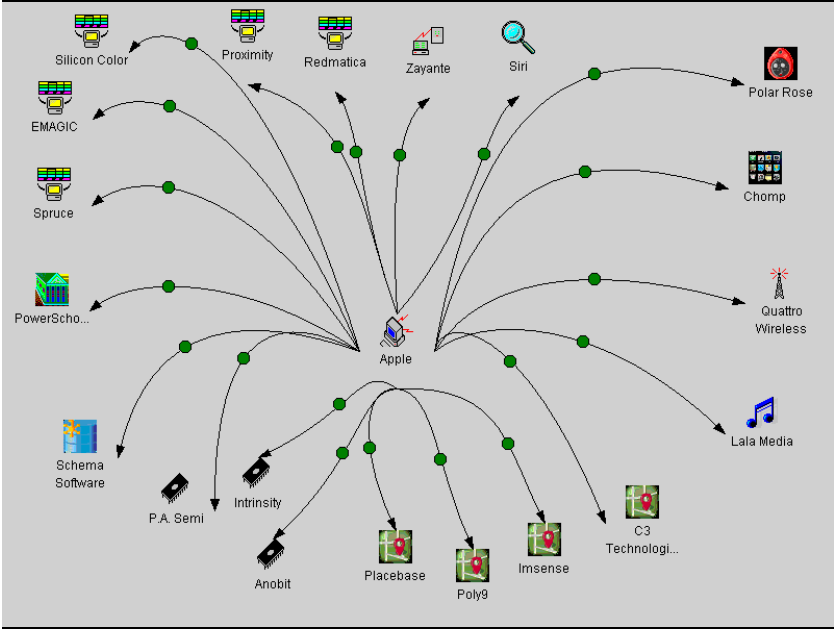
Apple acquisitions since 2001
By my count, to date Apple has made 20 company acquisitions since 2001. Apple is somewhat secretive about its M&A activity, so some digging is required to get to 20. Capital IQ (an authoritative deal source) lists only 16 company acquisitions for Apple during this period.

Apple has not been a particularly acquisitive company over this 12 year period. In contrast, Google acquired about twice as many companies in the year 2011 alone.

The infographic on the right depicts these 20 acquisitions, clustering the deals by market segment. You can view much more detail at Apple acquisitions since 2001.

Three clusters stand out: 1) Media application software (Spruce, EMAGIC, Silicon Color, Proximity and Redmatica). The most recent deal (Redmatica) develops applications used for sampling and editing audio files and for managing audio libraries; 2) Semiconductors (P.A. Semi, Intrinsity and Anobit). The most recent deal (Anobit) makes a key component that improves the performance of NAND flash memory chips, which are used in products such as iPhones, iPads, and iPods; 3) Mapping, imaging, drawing (Placebase, Poly9, Imsense, C3 Technologies). The most recent deal (C3) is a developer of three-dimensional mapping technology and now operates as the "Sputnik" division of Apple. This latter cluster of deals was particularly important as Apple moved away from using Google Maps in its new iOS 6.

Curiously, Redmatica (Italy), Anobit (Israel), and C3 Technologies (Sweden) were all headquartered outside of the US. Apple's M&A reach clearly has a global perspective.

Sunday, May 20, 2012

M&A Ecosystem Synergy: Much More than Sum of Parts

We’ve heard about M&A synergy, the notion (all too often fanciful) that the value of combined enterprises will exceed the sum of their individual values. Revenue synergies are anticipated top-line enhancements that will come from use of the acquirer’s superior distribution capability, or cross-selling of companies’ products, or effective integration across an industry value chain. Or, or, or… The list of possible revenue synergies is long.  Sometimes such synergies are real; often they are optimistically imaginative.

Cost synergies (such as head-count reduction from redundant overhead) are more in control of the acquirer. And these synergies tend to be more believable by Wall Street.

In any case, synergy can be represented by the equation V(A + T) > V(A) + V(T), where V(A) is the value of the Acquirer and V(T) is the value of the Target.

But consider what can be a potentially richer form of M&A synergy. Research findings suggest that initiation of a series of acquisitions as part of a strategic M&A program is associated with value creation for buyers. I believe this is especially true where ecosystem synergy can be realized.
Ecosystem synergy exists where target acquisitions have synergy with each other and not only with the acquirer. In other words, V(A + T1+ T2) > V(A+T1) + V(A+T2), where A stands for the Acquirer, and T1 and T2 stand for distinct Targets that have synergies with each other in addition to potential synergies with Acquirer.

Consider an example. Google has engaged in a series of advertising-related acquisitions that have helped the company cover the entire value chain of advertising. These acquisitions include Invite Media, DoubleClick, Admeld, and AdMob.

In the Internet world, ads typically start with the advertiser and go through an ad agency to a demand side platform (Invite Media), then to ad exchange (DoubleClick), then to supply side platform (Admeld), finally reaching users through services such as YouTube. In addition, the AdMob acquisition gives Google one of the largest mobile advertising networks. Google plans to integrate the AdMob network with DoubleClick's ad tools to ultimately operate a single platform across multiple devices. This is an excellent example of ecosystem synergy -- where target acquisitions enjoy synergy with each other and not only with the acquirer.

For more information on this constellation of deals, see http://www.trivergence.com/market.asp?MarketID=4107.

Research support provided by Debadutta Bhattacharyya and Ahreum Hong.

Thursday, May 17, 2012

Starbucks M&A in China: from Forbidden to Far and Wide

Starbucks entered China in 1999 and quickly opened a café within the Forbidden City. Chinese were horrified at the image of a U.S. coffee capitalist encroaching on traditional Chinese culture. The site became a lightning rod for controversy and eventually closed.

But Starbucks was sharpening its China vision, focusing on the development of goodwill, brand awareness and strong government relations. Consider a couple of recent moves. In February 2012, Starbucks established a joint venture with the Ai Ni Group, one of Yunnan Province’s most established agricultural companies and coffee operators. The goal is to support local farmers and help them enhance the quality of coffee that can be served within China. And in April, China Starbucks University was created, aiming to “elevate” the company’s China employees, with the noble goal of making Starbucks an employer of choice.
Starbucks intends to make China its second largest market (after the U.S.) by 2014 and plans over 1500 cafés in the country by 2015. There are at present about 600 Starbucks stores in China. The company is currently adding a store about every four days and plans to accelerate this pace.
Given this growth goal, corporate business development is changing in China. Originally, Starbucks entered China largely through minority share licensing agreements or joint ventures with quality corporate partners. Now the company is buying out partners such as Maxim Caterers in areas where Starbucks wants to accelerate growth. Starbucks will have full ownership of cafés in the provinces of Guangdong, Hainan, Sichuan, Shaanxi and Hubei, as well as the province-level municipality of Chongqing. Central, South and Western China is coming under full control of the company.
Starbucks intends to move from forbidden to far and wide.
Research assistance provided by Gaurav Vij

Saturday, April 7, 2012

Google's Major Acquisitions

Google's has done over 100 acquisitions over the past ten years. So which deals should we classify as significant? The largest deal by far (Motorola Mobility) involves consideration of about $12.5 billion. (This deal has been approved by U.S and EU antitrust authorities, but is still pending regulatory clearance is China, Taiwan and Israel.) The acquisition of Motorola Mobility is expected to substantially augment Google’s thin patent portfolio of about 2,000 patents, increasing it to 20,000+.

But size of transaction alone does not determine significance. Consider Google's 2005 purchase of Android, rumored to cost a mere $50 million. Android has driven quick adoption of Google's mobile platform, which has augured well for company's broader ad-based business model.

For our take on Google's most significant acquisitions, see the infographic at http://www.trivergence.com/market.asp?MarketID=4105. This visual is destined for change as Google's corporate acquisition machine continues its march forward.